


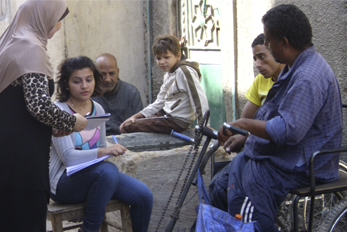
Last September 30 the agreement “Improvement of the social integration of disabled people in the Middle East through accessibility”, co funded by the AECID and with duration of 5 years has ended.
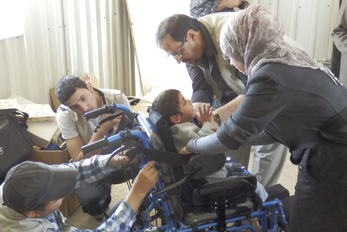 During this time, the Middle East has been under great stress, mainly, the Syrian conflict has led to the worst refugee crisis since the Second World War. Consequently, In Syria part of the planned activities were redesigned and thus physiotherapy and technical aids have been distributed to people with disabilities (PWD) of Aleppo and to the Syrian refugees in Za’atari refugee camp, to 70 km from Amman, where the FPSC managed care clinic to PWD.
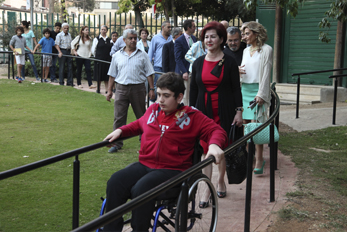 The aim of the Agreement has been to achieve accessibility from a threefold approach: physical spaces (adaptations in buildings and public spaces that allow access and movement of disabled), employment (development of vocational training and access to employment PWD) and virtual services (establishment of an internet platform www.accessibilityforpwd.org providing information and services in the four countries and managed by local partners themselves).
 Among the achievements, should highlight the following:
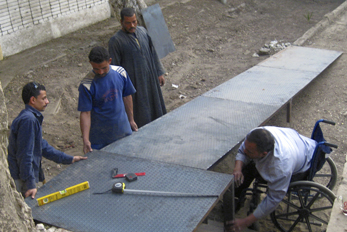
– 51 spaces have been adapted (8 in Lebanon, 7 in Syria, 15 in Jordan and 21 in Egypt). Among them are hospitals, schools, public parks, public offices, cultural or sports centers, health centers, two universities, etc. Many of these adaptations have been made by technicians who have been trained in the established workshops (1 in Syria, 2 in Jordan and 1 in Egypt), where a training program in 4 modules has been taught, all within the Agreement itself. These workshops are also developing their own adaptation projects, obtaining resources for its continuity. In total, more than 4,000 a year PWD are benefiting from these adaptations (ramps, lifts, toilets, adapted doors, handrails, light signals, etc.).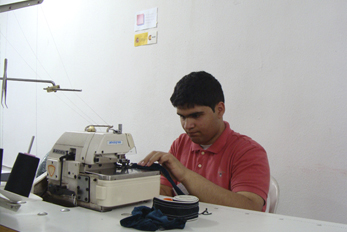
– Technical aids have been distributed and physiotherapy sessions conducted for 5,500 PWD in Syria and technical aids have been distributed to 500 PWD and physiotherapy sessions conducted 170 PWD in Lebanon.
– 660 PWD have been trained: 149 in Syria, 28 in Jordan and 483 in Egypt.
– Workshops were equipped : 4 in Syria: carpentry, upholstery, metalwork and sewing and 2 in Jordan in adaptations and assistive technology. In Egypt trainings have been made in workshops and in centres already established or contacted by the local partner, where courses in hairdressing, imitation jewellery, appliances, painting, sewing or carpentry were taught.
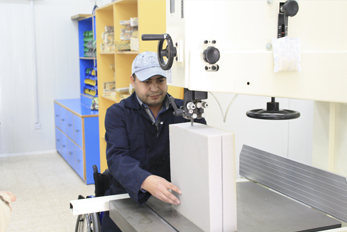 – The incorporation of 395 PWD to employment has been facilitated in Egypt and 7 in Syria (all men), as a result of the training.
– It has been created and is running the www.accessibilityforpwd.org portal and so are social networks in the four countries where information has been shared and communication has been facilitated on actions during implementation of the Agreement, as well as national laws, regulations, procedures and experiences of local partners. Currently, the number of visits is 1,000 people, half of them women.