





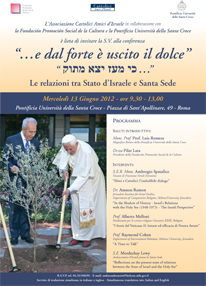
On 13 June in Rome, at the headquarters of the Pontifical University of the Holy Cross, a high-level meeting between exponents of the Catholic and Jewish world held the conference on relations between the state of Israel and the Holy See with the title “… And from stregnth was born sweetness (…e dal forte è uscito il dolce)”.
Relations between Jews and Catholics took a change of course with Vatican II and the theological documents that reiterated the continuity of Christianity with the Old Testament, a dialogue that does not have to be uniform, and is favored by friendship and attendance.
The meeting was organized by the Catholic Friends of Israel, with the collaboration of the Social Promotion of Culture (CEMOFPSC, Italy) and the Pontifical University of the Holy Cross of Opus Dei, where the meeting was held.
Among the speakers was Israel’s ambassador to the Holy See, Mordechay Lewy, who noted how the bilateral relations are, and indicated his efforts to reduce the cycle of the polemics between Jews and Catholics and existing mutual fears. He recalled that between the Vatican and Israel there are normative relations, not only political but also religious and spiritual. And on the specific agreements are expected to be signed, he considered that these are important although the bilateral relationship is much broader.
The other speakers were the Italian bishop MThe other speakers were the Italian bishop Monsignor Ambrogio Spreafico, Professor Amnon Ramon of the Israel Studies Institute of the Hebrew University of Jerusalem, Professor Alberto Melloni, Foundation Juan XXIII Religious Studies, Professor Raymond Cohen of the Department of International Relations of the University of Jerusalem. The event was chaired by the Deputy Director of the magazine 30 Days, Giovanni Cubeddu, and the introduction was given by the president of the FPSC, Pilar Lara, and the rector of the University, Prof. Luis Romera, who hosted the event.
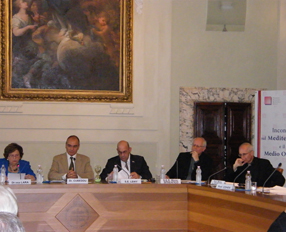
Among those present was Cardinal Farina and the chief rabbi of the Jewish community of Rome, Riccadro Segni, who was grateful for the conference and hoped for “these events to be disseminated to a wider audience” and “more community participation on these themes, and the next to be in Jerusalem.”
Bishop Spreafico recalled in his statement “the change that caused the Council on relations between Catholics and Jews after a long history marked by anti-Semitism,” whose origin had “teaching of contempt.” An interpretation of the data from the New Testament with roots in the early centuries of the Christian era, with the accusation of deicide which was established in the popular consciousness. Thus a theology that believed that with the coming of Jesus Christ, the Old Covenant had been replaced, creating an attitude that encouraged prosecution.
The Council document Nostra Aetate of Vatican II was at the root of this profound change in Catholic-Jewish relations, said the bishop, indicating a tipping point seen that “anti-Semitism was a problem of mentality, often the result of a religious education that saw Jews as the people responsible for the death of Christ.” In addition to the subsequent documents such as “Guidelines and Suggestions for the implementation of Nostra Aetate” in 1974 there were other documents in 1995 and 1998. And in the Jubilee of 2000 with “Memory and Reconciliation in the Church and the Faults of the Past” and the last of the Pontifical Biblical Commission “The Jewish People and Their Sacred Scriptures in the Christian Bible.” A dialogue – he said – not to make uniform the diversity.
The replacement theology of the Old Testament in the New Testament must therefore be radically reinterpreted, and here we must remember – said Bishop Spreafico – three times that showed the uniqueness of the relationship: the pilgrimage of John Paul II to the Holy Land in 2000, Benedict XVI’s visit to the synagogue in Cologne in 2005 and then to the Holy Land and the visit to the synagogue of Rome.
The bishop of Frascati meanwhile recalls that “one should not fall into the mistake of thinking that Jews and Christians have the Old Testament in common and their difference comes in the New Testament, as if Jews would be Christians but fell short. It is necessary to take the Mishna, the oral law mentioned in the rabbinic tradition and described in the Talmud. Because without the rabbinic tradition Judaism would not exist, and without Jesus and therefore without the New Testament, Christianity would not exist.
In conclusion Bishop Spreafico reminded the audience that Vatican II affirms that its relationship with Judaism is essential to the life of the Church, and not just in its living tradition. And that Pius IX on the very day after the publication in Italy of the racial laws, September 5, 1938, visibly disturbed, told a group of Belgian journalists who visited Castel Gandolfo: “Anti-Semitism is inadmissible. We are spiritually Semites. “
He recalled that Nostra Aetate, designed at first for relations between Christians and Jews, became then a paradigm for relations with other religions.
The idea of “a covenant never canceled,” indicated by John Paul II, Bishop Spreafico concluded, “may help us better understand Jewish-Christian relationship and make it grow by showing the perspective of friendship” but also “more than a simple idea which underlines the need for a relationship of esteem and respect, but also more frequency” And he recognized that fraternal relations were favored by many groups and individuals, such as the Hebrew Christian Friendship and the Community of Sant’Egidio, even before the existence of diplomatic relations. “I am convinced – he concluded – that these relationships have a permanent value, ensuring present and future hope” because “if the relations decrease, the documents will not influence reality.”
Meanwhile the president of the Foundation for Social Promotion of Culture, the Spanish Pilar Lara, in her words noted that the Center for Middle Eastern Studies was born in 2007 by them to create a forum for dialogue for peace and that this seminar has represented the continuation of a positive relationship with Israel that began with the Israeli ambassador Samuel Hadas.
Different media outlets, such as ROME REPORTS, the Zenit News agency, the Opusdei.org portal or website Catholic.net have reported on this conference.