





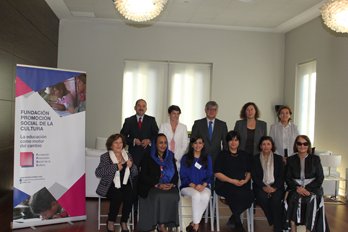
 The Social Promotion of Culture Foundation, organized, in collaboration with the Euro-Arab NGO Network for Development and Integration (READI) and Casa Árabe, the Seminar: “Libyan women: Rights and Responsibilities. Experiences in other Arab countries” during 25 and 26 October in the Hall of Ambassadors of Arab House in Madrid, funded by the Ministry of Foreign Affairs and Cooperation.
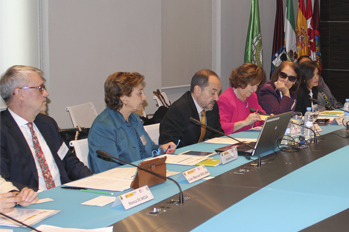 During the course of the seminar topics as the role of Libyan women in decision-making, the role of women in family and society and in strengthening the structure of local government in Libya were discussed.
Opening of the seminar, during the first day, had the intervention of Juan Manuel Molina, Executive Adviser at the Directorate General for the Maghreb, Africa, Mediterranean and Near East of the Ministry of Foreign Affairs and Cooperation of Spain, Pedro Antonio Villena, General Director of Casa Árabe, Jumana Trad, President of the FPSC, and Blanca de Mesa, President of READI NGO for Development and Integration.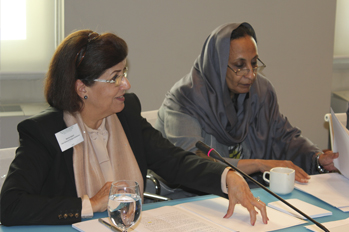
Next the conference on women and decision-making in Libya by Naima Gebril, Judge and member of Libya National Dialogue Comission, took place.
Naima Gebril was the first civil servant of the Ministry of Justice in Libya in 1975, and since then a strong advocate for women’s rights in Libya.
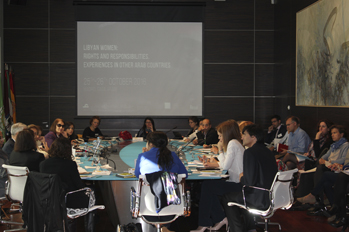 As revealed throughout his speech, women in Libya have to work hard to eliminate barriers that suffer in their path, motivated by the lack of democratic culture, after more than four decades of dictatorship, and the marginal role women have within the “tribes” that make up the Libyan society.
Next it took place a session devoted to the role of women in family and society.
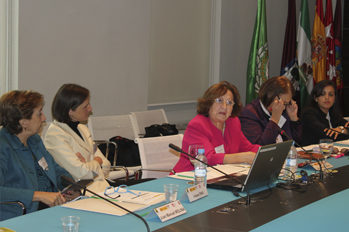 In this round table participated Magda El Sanousi, Head of UNSMIL `s Women Empowerment Section, Claudette Habesch, former President of Caritas MONA between 1999 and 2007, and Nada Elatrash, HSE Engineer at Repsol Exploration Murzuq S.A (REMSA).
Magda El Sanousi indicated that the chaos, lack of security mechanisms and the weak situation of institutions in Libya, involves a difficult and uncertain mobility of women within the country. In Libya, he stressed, society in general and the situation of women in particular, survives thanks to strong family ties.
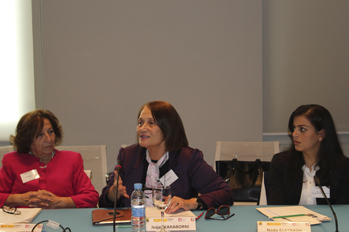 Claudette Habesch pointed out that it is not a question of getting more power but to have the same rights as men. For her, education is the key to social and economic development, and the greatest investment by governments that should be used to train teachers, and especially women teachers.
Nada Elatrash, on her turn, said the reputation of the family in her country rests on women.
She warned of the difficult situation in Libya, “in a society where every man carries a gun, women should be careful, go unnoticed, be invisible”. She said that they thought the revolution would bring improvements and changes for women but it has not been so, they still have much to do.
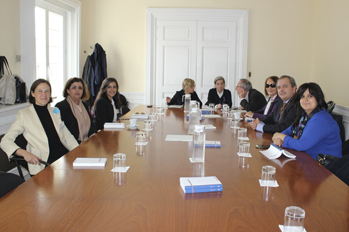 Najet Karaborni, President of FCO (Future & Civic Engagement Organization) and President Founder of TPM BEST (Tunisia Global Pole of Good Health & Well Being for All), moderated the session.
In the afternoon, participants at the seminar had a meeting at the headquarters of the Institute of Women and Equal Opportunities dedicated to explaining the Spanish legislation on women’s rights and equal opportunities, and the Spanish Constitution.
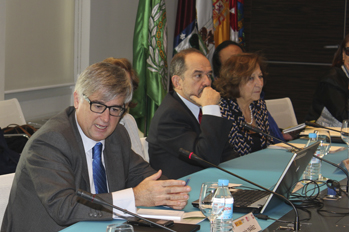 The opening of the second day was made by Ignacio Ybáñez, Secretary of State on Foreign Affairs Ministry at the Spanish Foreign Affairs and Cooperation.
In his speech, he stressed that gender equality and assuming positions of responsibility for women are two priorities of the foreign policy of Spain in the field of human rights.
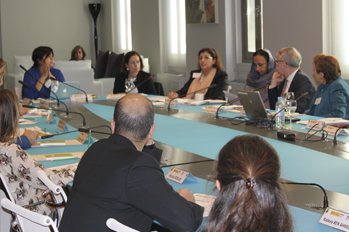 He reiterated Spain’s concern about the situation in Libya, its humanitarian problems, terrorism and in relation to traffic of women and the trafficking of human beings, in its capacity as neighbouring and friendly country, and its efforts to help the Libyans to find a solution including the support of the international community represented by the United Nations.
Next there was the session on the role of women in civil society.
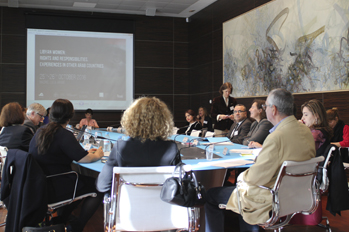 Mouna Akesbi, Cultural Advisor to the Moroccan Embassy in Spain, and Huda Abuzeid, TV Producer and of audiovisual content whose work has been issued internationally: BBC, Channel 4 and Al Jazeera, took part in it.
Mouna Akesbi remarked the situation of women in their country. He said that Morocco’s Constitution has created an authority of parity, and that 30% of parliamentary representation in the legislature is female. For her, one of the main challenges regarding women in Morocco is the political leadership and social participation of women.
Huda Abuzeid stressed that security is the biggest concern currently for Libyan women, in her words “the rights will come later.”
Najet Karaborni took care to comment on the main conclusions of the seminar prior to its closure by Jumana Trad.